Spot a lizard with tiny legs and no visible neck? You might struggle to identify it. Mistaking them for snakes or standard lizards leaves you confused about what actually lives in your garden. Understanding the true skink meaning clears up the mystery entirely. We break down exactly what these fascinating reptiles are, how they behave, and how to spot them in the wild.
Skink Definition & Meaning: A Detailed Overview
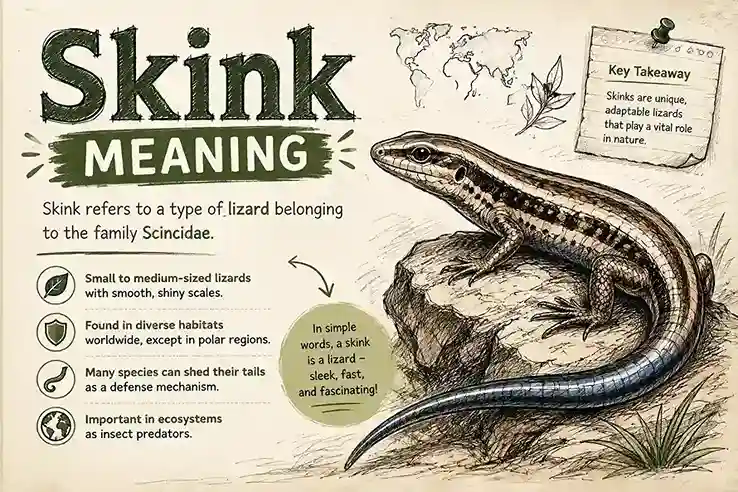
To fully grasp the skink meaning, we must look at both the biological facts and the physical traits of this reptile. Skinks are lizards belonging to the family Scincidae. They are the most diverse family of lizards on Earth.
Unlike typical lizards, skinks feature incredibly smooth, shiny scales. Most have very short legs, and some species have no legs at all. This unique body shape allows them to slide effortlessly through dirt, sand, and leaf litter.
Skink Fast Facts Table
| Feature | Detailed Description |
| Scientific Name | Scincidae |
| Main Diet | Insects, crickets, worms, snails, and small fruits |
| Habitat | Deserts, forests, grasslands, and suburban gardens |
| Key Physical Trait | Smooth, overlapping scales; little to no neck |
| Defense Mechanism | Autotomy (dropping their tails to escape predators) |
| Global Species Count | Over 1,500 distinct species worldwide |
Scincidae Family: The Scientific Background
Scientists classify skinks under the family Scincidae. When biologists discuss the scientific skink meaning, they refer to a massive group of over 1,500 species.
You will find these reptiles on every continent except Antarctica. They dominate warm, tropical, and temperate climates. Their evolutionary success comes from their incredible adaptability to different environments.
Key Physical Traits: How To Identify A Skink
Identifying a skink requires looking closely at its body structure. They look like a cross between a snake and a traditional lizard.
A true skink has no pronounced neck. Their head flows directly into their tubular body. They also possess overlapping scales that give them a glossy, polished appearance. If you see a thick, shiny lizard with stubby legs moving like a snake, you have likely found a skink.
Where Do Skinks Live?
Exploring the geographic skink meaning reveals a highly adaptable creature. Skinks thrive in almost every terrestrial habitat imaginable.
Many species prefer loose soil or thick leaf litter where they can burrow. You will spot them in Australian deserts, North American forests, and African savannas. They also love human habitats, frequently hiding under porch steps, garden logs, or outdoor debris.
The Skink Diet: What Do They Eat?
Skinks are primarily insectivores. Their daily diet keeps local bug populations under control.
They hunt grasshoppers, crickets, beetles, and caterpillars. Larger species, like the Blue-Tongued Skink, take an omnivorous approach. They eat insects alongside snails, berries, and leafy greens. Their strong jaws crush hard beetle shells and snail shells with ease.
The Magic Trick: Why Skinks Drop Their Tails
One of the most famous behaviors tied to the biological skink meaning is autotomy. Autotomy is the ability to amputate a body part to survive an attack.
When a bird or cat grabs a skink’s tail, the tail simply snaps off. The detached tail continues to wiggle aggressively on the ground. This movement distracts the predator while the skink escapes into the bushes. The reptile will eventually regenerate a new tail over several months.
Skinks vs. Snakes: Spotting The Difference
People frequently confuse legless skinks with snakes. However, understanding the anatomical skink meaning highlights clear differences.
First, skinks have eyelids and can blink. Snakes cannot blink because they possess clear scales over their eyes instead of eyelids. Second, skinks have visible ear openings, whereas snakes lack external ears entirely. Finally, even legless skinks have a fleshy, notched tongue rather than the deeply forked tongue of a snake.
Reproduction: Egg Layers And Live Bearers
Skink reproduction varies wildly depending on the species and the climate. About 55% of skink species are oviparous, meaning they lay eggs.
The mother usually buries her eggs in warm, moist soil and leaves them to hatch. However, the other 45% of species are viviparous. These skinks give birth to live young. Live-bearing skinks usually live in colder climates where buried eggs would freeze.
Popular Types Of Skinks
To expand your knowledge of the skink meaning, you should know the most famous varieties.
- Blue-Tongued Skink: Native to Australia, known for its bright blue tongue used to scare off threats.
- Five-Lined Skink: Common in North America, featuring bright yellow stripes and a vivid blue tail in its youth.
- Red-Eyed Crocodile Skink: Found in New Guinea, featuring spiky scales that make it look like a tiny dragon.
- Sandfish Skink: A desert dweller that literally “swims” through loose sand to hide from the sun.
Can You Keep A Skink As A Pet?
Reptile enthusiasts love keeping skinks. The pet trade heavily influences the modern skink meaning for hobbyists.
Blue-tongued skinks make fantastic pets for beginners. They possess calm temperaments, move slowly, and tolerate human handling very well. Providing a proper terrarium with UV lighting, a basking spot, and a varied diet ensures your pet lives a long, healthy life.
(External Reference: The San Diego Zoo Wildlife Alliance provides good advice on reptile terrarium installations for thorough husbandry).
The Ecological Role Of Skinks
Skinks act as vital players in our global ecosystems. They are both essential prey and active predators.
By eating thousands of insects, they naturally protect crops and gardens from pest infestations. At the same time, they provide a crucial food source for birds of prey, snakes, and small mammals. Protecting skink habitats ensures the food web remains stable and balanced.
Frequently Asked Questions (FAQs)
What is the spiritual skink meaning?
Answer: The spiritual skink meaning represents survival, adaptability, and regeneration.
Because skinks can shed their tails and grow new ones, many cultures view them as symbols of leaving the past behind. They remind humans to let go of dead weight and adapt to new situations to survive.
Does the skink meaning change depending on the region?
Answer: Yes, the cultural skink meaning shifts based on geography.
In North America, gardeners view them as helpful pest controllers. In certain parts of Africa and the Middle East, local myths falsely label them as venomous or dangerous omens, though they are completely harmless.
Are skinks poisonous to humans or pets?
Answer: No, skinks are entirely non-venomous and non-poisonous.
A thorough review of the skink meaning confirms they pose no danger to humans, dogs, or cats. If a cat eats a skink, the cat will not suffer from poisoning.
How long do skinks usually live?
Answer: A skink’s lifespan depends entirely on its species and living conditions.
Smaller wild skinks usually live 3 to 5 years due to high predator threats. Larger species kept in captivity, like the Blue-Tongued Skink, can live anywhere from 15 to 20 years with proper care.
Do skink bites hurt?
Answer: Most skink bites feel like a small, sudden pinch.
Small garden skinks cannot break human skin. Larger species have stronger jaws to crush snails, so their bite might cause mild pain, but they only bite if severely provoked or handled roughly.
Can a skink grow its tail back multiple times?
Answer: Yes, but the regenerated tail is never quite the same.
When exploring the anatomical skink meaning, we see the new tail grows back using cartilage instead of bone. It usually looks shorter, stubbier, and slightly different in color than the original tail.
Final Thoughts On The Skink
Understanding the true skink meaning reveals how incredible these little reptiles actually are. They are not snakes, and they are far more than just standard lizards. From their glossy scales and unique pest-control abilities to their magic trick of dropping their tails, skinks command respect in the animal kingdom.
If you spot one darting under a rock in your garden, let it stay. You now have a natural, harmless pest controller working for you around the clock. Share this guide with your fellow nature lovers to help them identify the fascinating reptiles living right in their own backyards!