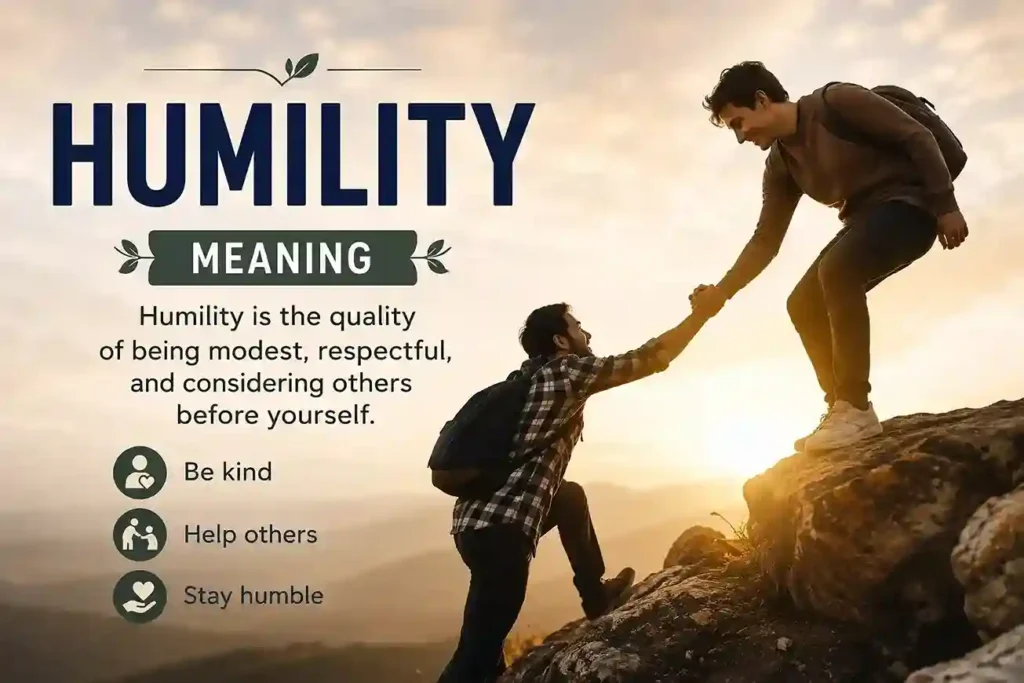
Most people have humility completely backwards. They think it means shrinking yourself, staying silent, or letting others walk all over you. That misunderstanding is costing them in every area of life — careers, relationships, and personal growth.
The real humility meaning is nothing like what you were taught. And once you see it clearly, you’ll start spotting it in every high-performing person you’ve ever admired.
The Real Humility Meaning (Beyond the Dictionary)
The dictionary says humility is “a modest view of one’s own importance.” That’s technically accurate and almost completely useless as a definition.
Real humility isn’t about thinking less of yourself. It’s about thinking of yourself less — there’s a huge difference. A humble person carries full confidence in their abilities while remaining genuinely open to being wrong, learning more, and crediting others.
Think of it as intellectual honesty with yourself. You know what you’re good at. You also know exactly what you don’t know — and you’re comfortable saying both out loud without anxiety.
Humility vs. Low Self-Esteem: Don’t Confuse the Two
This is one of the most common mix-ups in psychology and everyday conversation. Low self-esteem means you doubt your worth. Humility means you’re secure enough in your worth that you don’t need constant external validation.
A person with low self-esteem avoids challenges because they fear failure will define them. A humble person takes on challenges precisely because they’re not afraid of being wrong — failure is just data.
Humility requires a strong inner foundation. You can’t genuinely be humble if you’re secretly terrified of what people think of you. The ego and humility aren’t opposites — they’re on completely different planes.
The Psychological Science Behind Humility
Research backs this up clearly. A 2017 study published in Personality and Individual Differences found that humble people score higher on emotional intelligence, openness to experience, and agreeableness — without the fragility that typically comes with people-pleasing.
Humble individuals also show stronger “intellectual humility” — the ability to say “I might be wrong” without feeling like the ground is dissolving under their feet. That one trait alone predicts better decision-making across both personal and professional domains.
7 Signs You’re Genuinely Humble (Without Even Realizing It)
Humble people rarely identify as humble. That’s almost a defining feature. Here are the real signs:
- Not because you don’t have opinions — because you know someone in the room might have a better one.
- You change your mind publicly and feel fine about it. Ego requires you to defend old positions. Humility just requires you to track what’s true.
- You share credit reflexively. Not performatively — you actually remember who helped and you say so.
- You listen without planning your reply. This is rare and unmistakable when you see it.
- You don’t need to win every room. Quiet confidence doesn’t require an audience.
- You can take direct feedback without it wrecking your week. Criticism hits humble people differently — it’s useful, not threatening.
- You notice when someone else in the conversation knows more than you — and you lean in instead of deflecting.
If three or more of those describe you on a normal Tuesday, you’re already further along than most.
Why Humble People Actually Win More in Life
Here’s what nobody talks about in hustle culture: humility is one of the highest-leverage traits for long-term success. Not in a soft, feel-good way — in a measurable, compounding way.
| Area of Life | How Humility Creates an Edge |
|---|---|
| Leadership | Teams trust humble leaders more, perform better, and stay longer |
| Learning | Humble learners absorb feedback faster and close skill gaps quicker |
| Relationships | Humble partners de-escalate conflict and build deeper trust |
| Decision-Making | Humble thinkers check blind spots, reducing costly errors |
| Reputation | Humble people are described as “real” — a quality that compounds over years |
The data on humble leaders is particularly striking. A study in the Journal of Applied Psychology found that teams led by humble managers showed 35% higher engagement scores compared to those led by confident-but-arrogant counterparts.
Humility in the Workplace
In a workplace context, humble employees and leaders do something most people don’t: they make the people around them better. They give feedback that actually helps instead of feedback designed to position themselves.
This creates what organizational psychologists call “psychological safety” — an environment where people speak up, admit mistakes early, and solve problems faster. Humble people don’t just benefit themselves.
Humility in Relationships
In personal relationships, humility acts like a slow-release glue. It allows you to apologize first without scorekeeping, to hear your partner’s frustration without immediately defending yourself, and to hold space for someone else’s reality even when it clashes with yours.
Couples who describe each other as “humble” in relationship studies report higher satisfaction, fewer recurring arguments, and better repair after conflict. It’s not romantic poetry — it’s a practical advantage that shows up every week in real life.
Famous Examples of Humility That Changed History
Nelson Mandela spent 27 years in prison and emerged without publicly displaying bitterness. He consistently redirected attention to the collective struggle rather than his own suffering — a display of humility that made him a globally trusted leader rather than just a political figure.
Warren Buffett famously still lives in the same modest Omaha home he bought in 1958 for $31,500. He regularly attributes his success to luck, timing, and the people around him — despite being one of the most skilled investors in history. That isn’t false modesty. It’s an accurate accounting of reality.
Satya Nadella transformed Microsoft’s culture after taking over as CEO in 2014 specifically by modeling intellectual humility — publicly admitting what the company had gotten wrong and building a culture where learning mattered more than looking smart.
How to Practice Humility Every Day
Humility isn’t a personality type you’re born with or without. It’s a practice, and like most practices, it gets easier with repetition.
- Start meetings by asking what you’re missing. Literally say it: “What am I not seeing here?”
- Write down one thing you got wrong this week. No judgment — just notice.
- Give credit before someone has to ask for it. Make it your default, not your exception.
- Pause before defending a position. Ask: “Am I defending this because it’s right, or because I said it?”
- Spend time with people who know more than you in a specific area. Don’t perform competence — absorb theirs.
Small, consistent actions compound fast. You don’t overhaul your ego in a week, but you can shift patterns noticeably within 30 days.
Frequently Asked Questions
What is the simple meaning of humility?
Humility means having an accurate, grounded view of yourself — not inflated, not deflated. It means recognizing your strengths, acknowledging your limits, and staying genuinely open to learning from anyone.
Is humility a sign of weakness?
No — it’s the opposite. Humility requires enough inner security that you don’t need external validation to feel stable. That’s a sign of strength, not weakness. Arrogance is often the mask people wear when they’re secretly insecure.
What’s the difference between humility and modesty?
Modesty is primarily about how you present yourself to others — downplaying achievements, avoiding showing off. Humility goes deeper. It’s an internal orientation: a genuine openness to being wrong, learning more, and valuing others’ contributions regardless of whether anyone is watching.
How does humility affect mental health?
Research consistently links humility to lower anxiety, better coping strategies, and stronger social connections. When you’re not constantly defending a self-image, you free up significant mental energy. Humble people also tend to show greater gratitude — which is independently linked to improved wellbeing.
Why do humble people often get overlooked in competitive environments?
Because humility is quiet and ego is loud. In short-term, performance-review-driven cultures, the person who claims the most credit often appears to have done the most work. Over longer timescales, however, humble performers tend to build deeper trust, broader networks, and more sustainable track records.
How is humility taught to children?
Children develop humility best through modeling, not lecturing. When adults admit mistakes openly, show curiosity, and thank others publicly, children absorb those patterns. Praising effort and process over innate ability also helps children develop what psychologist Carol Dweck calls a “growth mindset” — a close cousin of intellectual humility.
The Quiet Edge You’ve Been Ignoring
Humility won’t make headlines for you. It won’t win you the loudest applause in the room. But it will build you the kind of reputation, relationships, and inner clarity that most people spend decades chasing with louder, flashier strategies.
The world keeps optimizing for visibility. Quietly, humble people keep winning the things that actually matter. Now that you know what humility meaning really looks like in practice — the only question is what you do with that on Monday morning.