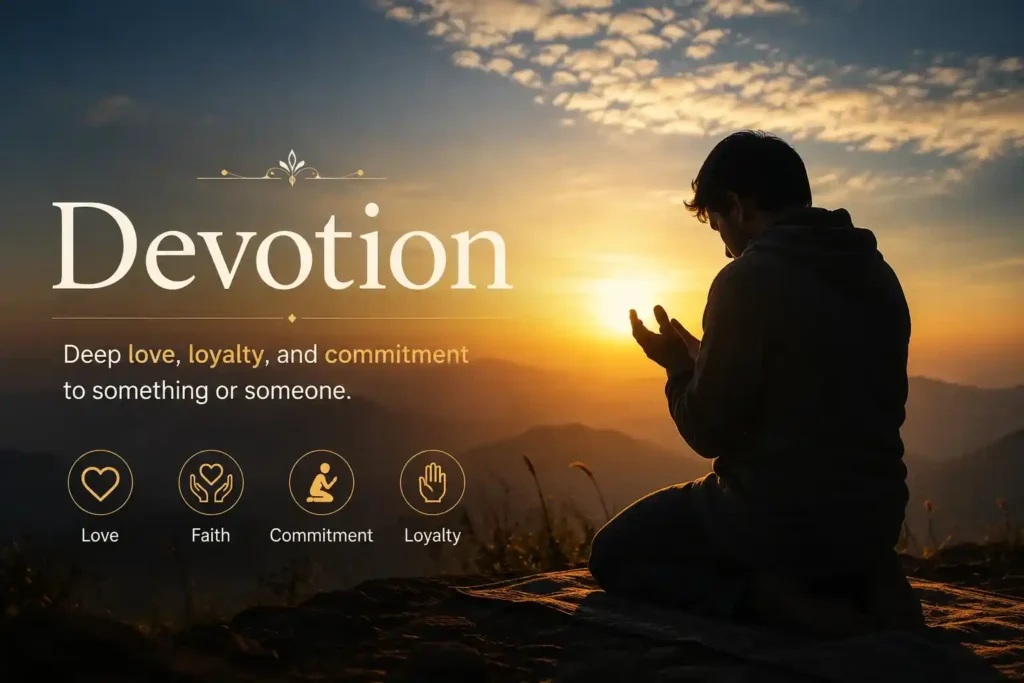
Most people think devotion is just a word for being loyal or religious. That’s a surface-level take — and it keeps people from experiencing one of the most transformative forces in human life.
The real devotion meaning runs deeper than Sunday prayers or romantic gestures. It shapes how you show up for the people you love, the goals you chase, and the person you’re quietly becoming every single day.
The Core Devotion Meaning — What the Word Actually Tells You
The word “devotion” comes from the Latin devotio, rooted in devovere — meaning to vow, to dedicate, to consecrate something to a greater purpose. That origin matters more than most dictionaries admit.
When you strip away the poetry, devotion means a sustained, active commitment to something beyond your immediate comfort or convenience. It’s not a feeling you wait for. It’s a choice you make — over and over again.
That distinction between feeling devoted and practicing devotion is where most people get stuck. Feelings fade. Practice builds character.
Devotion Meaning Across Different Areas of Life
Devotion doesn’t live in just one category. It shows up differently depending on context — and understanding each version helps you recognize where it’s already working in your life.
Devotion in Relationships
In relationships, devotion means choosing someone consistently — not just when things feel easy, but when things get hard, boring, or uncertain. It’s the quiet decision to keep showing up.
Devotion in love isn’t the same as obsession. Obsession is about control. Devotion is about contribution — what you’re actively giving to the relationship without keeping score.
Healthy devotion in a partnership also includes boundaries. You can be deeply devoted to someone and still maintain your own identity, goals, and emotional health.
Devotion in Religion and Spirituality
In spiritual contexts, devotion is one of the oldest human practices. Across Christianity, Islam, Hinduism, Buddhism, and virtually every major faith tradition, devotion represents a dedicated relationship with the divine.
Devotional practices vary widely — prayer, meditation, chanting, fasting, pilgrimage. But the common thread is intention. Every practice is a physical act that points the mind and heart toward something greater than the self.
In Hinduism, the concept of Bhakti (devotional love toward God) is considered one of the highest spiritual paths. In Sufi Islam, devotion through dhikr (remembrance) is a gateway to inner transformation. The form changes. The function doesn’t.
Devotion in Work and Personal Goals
Professional devotion gets underrated. When someone is genuinely devoted to their craft — not just grinding for money or status — the quality of their work tells you immediately.
Think of a surgeon who reads case studies on weekends, not because they have to, but because they care deeply about getting better. That’s devotion. It’s the same energy a musician channels when they practice scales long after they’ve already “made it.”
This kind of devotion isn’t workaholism. Workaholism is driven by anxiety. Devotion is driven by genuine love for what you do and who you’re doing it for.
How Devotion Appears Across Major Traditions (Comparison Table)
| Tradition | Term for Devotion | Primary Expression | Core Purpose |
|---|---|---|---|
| Christianity | Piety / Worship | Prayer, Scripture, Service | Union with God |
| Hinduism | Bhakti | Chanting, Rituals, Surrender | Liberation (Moksha) |
| Islam | Tawadu / Ibadah | Salah, Dhikr, Fasting | Submission to Allah |
| Buddhism | Saddha (Faith) | Meditation, Offerings | Awakening (Nirvana) |
| Secular/Humanist | Commitment | Work, Relationships, Causes | Personal Fulfillment |
What this data shows: Devotion isn’t a religious concept that got borrowed by secular culture. It’s a universal human orientation that every major civilization has named, studied, and practiced for thousands of years. The labels differ. The human need underneath is identical.
Real Signs You’re Already Living With Devotion
You don’t need to be a monk or a saint to practice devotion. Here’s what it actually looks like in everyday life:
- You keep promises — especially the ones no one is watching you keep
- You invest time in something without needing immediate results
- You feel a sense of loss when you neglect a relationship, practice, or goal
- You think about the people or things you care about unprompted
- You push through discomfort because the purpose feels bigger than the pain
- Your attention keeps returning to the same person, craft, or calling — naturally, not forcibly
If you recognize three or more of these in your own life, devotion is already in motion. The question is whether you’re directing it wisely.
The Psychology Behind Devotion (What Science Says)
Psychologists link deep devotion to what researchers call identity fusion — the point where a person’s sense of self becomes intertwined with a person, group, or cause. This isn’t pathology. It’s how humans form deep meaning.
Studies on long-term couples show that sustained devotional behavior — acts of service, consistent attention, sacrifice — activates the brain’s reward circuitry similarly to early-stage romantic love. The chemistry evolves, but the neurological payoff of devoted action remains.
Research from Viktor Frankl’s logotherapy also supports this. People who feel devoted to something — a cause, a family, a creative pursuit — demonstrate dramatically higher levels of psychological resilience, especially during hardship.
Devotion, in short, isn’t just a virtue. It’s a mental health strategy that the human brain is literally wired to reward.
FAQs About Devotion Meaning
What is the simple meaning of devotion?
Devotion means a deep, sustained commitment to a person, practice, belief, or cause. It goes beyond temporary interest — it involves consistent action, sacrifice, and genuine care over time.
What is the difference between devotion and love?
Love is an emotion — it can rise and fall naturally. Devotion is a practice built on top of love. You can feel love without acting on it. Devotion means actively showing up for what or who you love, even when the feeling isn’t at its peak.
Can devotion be unhealthy?
Yes. Devotion crosses into unhealthy territory when it leads to self-abandonment, enabling harmful behavior, or obsession masked as loyalty. Healthy devotion includes maintaining your own needs, boundaries, and identity alongside your commitment to others.
What does devotion mean in a relationship?
In a relationship, devotion means choosing your partner with consistency — through disagreements, distance, and daily life. It shows up in how you listen, how you prioritize them, and how you honor the commitment you’ve made even when it costs you something.
Is devotion a spiritual word only?
No. While devotion has strong spiritual roots, it applies equally to secular life — devotion to a career, a family, a fitness goal, or a creative pursuit. Any sustained, meaningful commitment qualifies.
How do you build devotion?
Devotion grows through repetition and intentionality. Start small: commit to one daily practice, one relationship, or one goal with full presence. Over time, the habit deepens into genuine devotion. What you consistently return to becomes what you’re devoted to.
What is an example of devotion in daily life?
A writer who works on their manuscript every morning before the rest of the world wakes up. A friend who shows up to help you move without being asked twice. These are all devotion — in plainclothes.
The Final Word on Devotion Meaning
Devotion isn’t a grand gesture or a rare spiritual achievement. It’s the quiet, consistent act of returning — to the people, the work, and the values that matter most to you.
The most devoted people aren’t always the loudest or the most visible. They’re the ones whose commitments hold steady under pressure, whose actions align with their words month after month.
Whatever you’re devoted to right now — tend to it. The world rewards consistency in ways that inspiration alone never can.