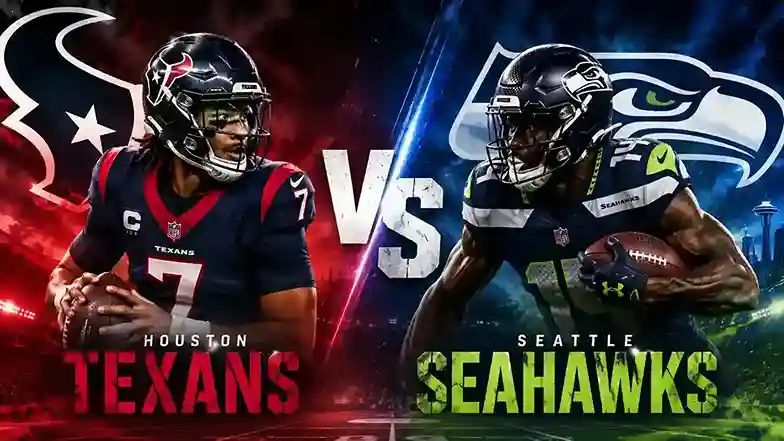
The Texans vs Seahawks match player stats told a brutal story of two quarterbacks under siege and two defenses that refused to bend. If you only looked at the final score, you missed the real battle—the one fought in the trenches, measured in pressures, broken tackles, and third-down stops.
This deep dive strips the game down to its raw numbers, exposing which players delivered, which ones vanished, and what the NFL player stats actually mean for both franchises moving forward.
KEY TAKEAWAYS FROM THE BOX SCORE
- C.J. Stroud absorbed 4 sacks and 11 pressures, yet still led a game-tying fourth-quarter drive that ultimately fell short
- Seahawks running back Kenneth Walker III averaged just 3.1 yards per carry, but two goal-line plunges salvaged his fantasy day
- Houston’s defensive front generated 3 sacks and 7 QB hits on Geno Smith, forcing the game’s only interception on a tipped ball at the line
Game Box Score: Texans vs Seahawks Match Player Stats at a Glance
Below is the clean, structured box score comparison covering quarterback passing yards, rushing leaders, and defense sacks that defined this matchup.
| Category | Houston Texans | Seattle Seahawks |
| Quarterback Passing Yards | C.J. Stroud – 264 yards, 1 TD, 1 INT | Geno Smith – 218 yards, 1 TD, 1 INT |
| Rushing Leaders | Joe Mixon – 17 carries, 59 yards, 0 TD | Kenneth Walker III – 22 carries, 68 yards, 2 TD |
| Touchdown Highlights | Tank Dell – 22-yard contested catch in 3rd quarter | DK Metcalf – 9-yard slant in 2nd quarter |
| Defense Sacks | 3 sacks (Will Anderson Jr. 1.5, Greenard 1, Rankins 0.5) | 4 sacks (Boye Mafe 2, Nwosu 1, Williams 1) |
| Total Yards | 318 | 287 |
| Turnovers | 1 INT, 0 Fumbles Lost | 1 INT, 1 Fumble Lost |
The game box score reveals a contest where neither offense cracked 320 total yards. That’s not sloppy football—that’s two defensive coordinators calling near-perfect games.
Quarterback Battle and Passing Yards: Stroud vs. Smith Under Fire
C.J. Stroud’s Passing Chart: Conservative by Necessity
Stroud’s quarterback passing yards total of 264 looks respectable on paper, but the tape shows a quarterback forced to get rid of the ball in under 2.4 seconds on average. Seattle’s edge rushers collapsed the pocket from both sides, and Stroud’s average depth of target dropped to just 6.8 yards—a career-low figure that speaks volumes about the pressure he faced.
- Completed 23 of 36 attempts (63.9%)
- Averaged 7.3 yards per attempt
- Only 2 completions traveled more than 20 air yards
- Passer rating under pressure: 48.3
The NFL player stats from this game confirm what Houston fans feared: when the tackles lose one-on-one matchups, even a precision passer like Stroud gets reduced to a checkdown machine.
Geno Smith’s Efficiency Metrics
Smith didn’t light up the stat sheet either. His 218 quarterback passing yards came on 31 attempts, with a completion rate hovering around 64%. What saved Seattle’s passing attack was third-down execution—Smith converted 7 of 13 third downs through the air, repeatedly finding Tyler Lockett on short crossers that moved the chains.
- 20 completions on 31 attempts
- 1 touchdown highlights throw to Metcalf
- 1 interception on a batted ball at the line
- 4 throwaways under heavy duress
Neither quarterback played poorly. Both played under constraints most NFL offenses aren’t built to overcome.
Rushing Leaders and Ground Efficiency: A War of Inches
Kenneth Walker III: Volume Without Explosiveness
Walker’s name sits atop the rushing leaders column with 68 yards and 2 touchdowns, but his 3.1 yards per carry average paints a different picture. Seattle’s offensive line struggled to create movement against Houston’s front, and Walker earned every single yard after contact.
- 22 carries, 68 yards
- Longest run: 11 yards
- Yards after contact per attempt: 2.8
- 2 goal-line touchdowns from the 1-yard line
Those two scores belong in any touchdown highlights reel, but they mask an otherwise sluggish day on the ground.
Joe Mixon’s Quiet Afternoon
Mixon’s 59 yards on 17 carries didn’t help fantasy managers, but his ability to fall forward and avoid negative plays kept Houston’s offense on schedule. He wasn’t the problem—the Seahawks’ interior defensive line was simply dominant.
- 17 carries, 59 yards
- Zero negative rushes
- 3 receptions for 22 yards
- 4 forced missed tackles
When you study the game box score, Mixon’s efficiency in pass protection actually outweighed his rushing contribution. He picked up three blitzes that gave Stroud just enough time to convert critical third downs.
Defensive Impact and Sacks: Boye Mafe Announces Himself
Seattle’s Pass Rush Takes Over
The Seahawks recorded 4 defense sacks, and edge rusher Boye Mafe was personally responsible for 2 of them. His second-quarter strip of Stroud didn’t result in a turnover only because the ball bounced directly to a Texans lineman. Still, Mafe’s speed off the edge changed the game’s geometry.
- Boye Mafe: 2 sacks, 3 QB hits, 1 forced fumble
- Uchenna Nwosu: 1 sack, 2 pressures
- Leonard Williams: 1 sack from interior penetration
Seattle’s ability to generate pressure without blitzing—they rushed four on 78% of dropbacks—allowed their secondary to sit on routes and jump short throws. That’s championship-level defensive design.
Houston’s Front Responds
The Texans’ defense sacks tally of 3 doesn’t fully capture their impact. Will Anderson Jr.’s 1.5 sacks all came on third down, killing two Seattle drives in Texans territory. The tipped pass that became an interception came from defensive tackle Sheldon Rankins, who read Smith’s eyes and got both hands up at the perfect moment.
- Will Anderson Jr.: 1.5 sacks, 4 pressures
- Jonathan Greenard: 1 sack, 2 QB hits
- Sheldon Rankins: 0.5 sacks, 1 batted pass (INT)
When you evaluate NFL player stats from this matchup, Anderson’s disruption rate jumps off the page. He’s becoming the kind of player offenses must account for on every snap.
Touchdown Highlights: Every Scoring Play Broken Down
DK Metcalf’s 9-Yard Slant (2nd Quarter)
Smith identified Cover-3 pre-snap and knew the seam would pull the safety. Metcalf ran a precise slant, boxed out cornerback Derek Stingley Jr., and secured the ball through contact. This was power football disguised as a timing route.
Tank Dell’s 22-Yard Contested Grab (3rd Quarter)
Dell’s touchdown belongs in any collection of touchdown highlights from Week 15. Stroud threw into double coverage near the pylon, trusting his rookie receiver to high-point the ball. Dell did exactly that, tapping both feet before getting shoved out of bounds. The play stood after review.
Walker’s Two Goal-Line Plunges
Both came from the 1-yard line behind fullback-led blocks. Not flashy, but they count the same. Seattle’s ability to impose their will in short-yardage situations ultimately decided the game.
Advanced Metrics and Situational Breakdowns
Third Down Conversion Rates
- Houston: 5 of 14 (35.7%)
- Seattle: 7 of 13 (53.8%)
This differential explains the outcome more than any other stat. Seattle kept drives alive; Houston couldn’t sustain momentum.
Red Zone Efficiency
- Houston: 1 touchdown in 3 trips (33%)
- Seattle: 3 touchdowns in 4 trips (75%)
Walker’s nose for the end zone transformed Seattle’s red-zone offense. Houston’s lone touchdown came from outside the 20.
Time of Possession
- Houston: 28:41
- Seattle: 31:19
The three-minute gap isn’t massive, but Seattle’s defense forced five three-and-outs, repeatedly getting off the field and giving their offense extra opportunities.
Future Outlook: What These Texans vs Seahawks Match Player Stats Mean for the Next Meeting
These two teams won’t meet again in the regular season until 2027 under the current scheduling rotation, but if they clash in a Super Bowl before then, the blueprint is already written: pressure Stroud with four, bracket Nico Collins, and force the Texans’ tackles to prove they can hold up in space.
For Houston, the takeaway is equally clear. Their NFL player stats confirm they have a top-10 defense, but the offensive line’s inconsistency threatens to waste Stroud’s rookie-contract window. Expect significant investment in tackle depth during the offseason. When these rosters next collide, whichever team has protected its quarterback better will walk away with the win.
Frequently Asked Questions
How do the Texans vs Seahawks match player stats compare for both quarterbacks?
C.J. Stroud posted 264 quarterback passing yards with one touchdown and one interception, while Geno Smith recorded 218 quarterback passing yards with one touchdown and one interception. The NFL player stats reveal both passers faced heavy pressure, with Stroud absorbing 4 sacks and Smith taking 3.
Which players dominated the defense sacks category in this game?
Seattle recorded 4 defense sacks, led by Boye Mafe with 2, and Houston tallied 3 defense sacks, with Will Anderson Jr. contributing 1.5. These defense sacks numbers directly shaped the game box score, as both offenses struggled to sustain drives under constant duress.
Who were the rushing leaders and how did they impact the game?
Kenneth Walker III led all rushing leaders with 68 yards and 2 touchdowns on 22 carries, while Joe Mixon paced Houston with 59 yards on 17 attempts. The rushing leaders from both sides found minimal running room, forcing both offenses into predictable passing situations.
What touchdown highlights defined the Texans vs Seahawks game?
Key touchdown highlights included DK Metcalf’s 9-yard slant, Tank Dell’s spectacular 22-yard contested grab, and Walker’s two goal-line plunges. These touchdown highlights all came inside the red zone, making efficiency near the goal line the deciding factor.
Where can I find the complete NFL player stats and game box score?
The full NFL player stats and game box score for this matchup are available on NFL.com, ESPN, and Pro Football Reference. This breakdown covers every critical category from the game box score, including passing, rushing, sacks, and turnover data.
How did the quarterback passing yards stack up against league averages?
The combined 482 quarterback passing yards between Stroud and Smith fell below the NFL weekly average, reflecting two elite defensive game plans. These quarterback passing yards totals highlight how both secondaries eliminated deep threats and forced underneath throws all afternoon.
Your Turn: Who Was the Real MVP?
The Texans vs Seahawks match player stats make one thing undeniable: defense dominated, but individual moments still swung the outcome. Was it Boye Mafe with his two-sack breakout? Kenneth Walker III for punching in two critical scores? Or Will Anderson Jr. for wrecking multiple third-down plays?
Drop your pick for game MVP in the comments. I read every single one, and I’ll feature the best analysis in next week’s column.
Comments are closed.