Quick Summary
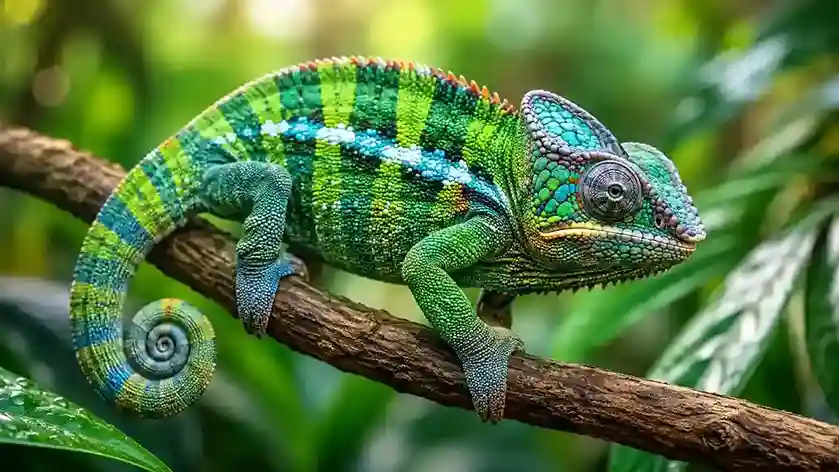
Chameleónovité is the Slovak and Czech scientific term for Chamaeleonidae, the biological family of chameleons. This group includes over 200 species of highly specialized arboreal lizards known for independently rotating eyes, ballistic tongues, and iridophore-based color shifting driven by guanine nanocrystals.
Few reptile groups capture human imagination quite like chameleons. Whether you encountered the term Chameleónovité in a Central European biology textbook or stumbled across it while researching exotic wildlife, the meaning is the same: it refers to the biological family Chamaeleonidae, the taxonomic home of all true chameleons.
These remarkable lizards belong to the order Squamata and diverged from other iguanian lineages roughly 60–90 million years ago. Today, the Chameleónovité family encompasses more than 200 recognized species spread across sub-Saharan Africa, Madagascar, southern Europe, the Middle East, and parts of South Asia.
From the tiny Brookesia micra—small enough to balance on a match head—to the imposing Parson’s chameleon stretching over 60 centimeters, this family showcases extraordinary evolutionary diversity. This guide covers their taxonomy, anatomy, color-change science, ecology, and the urgent conservation challenges they face.
[Internal Link: Beginner’s Guide to Reptile Taxonomy and Classification]
What Is the Chameleónovité Family? (Taxonomy & Evolutionary Lineage)
Chameleónovité (Chamaeleonidae) is a monophyletic family of Old World lizards within the infraorder Iguania, characterized by fused eyelids, zygodactylous feet, and projectile tongues.
The family splits into two subfamilies: Chamaeleoninae (typical chameleons) and Brookesiinae (dwarf and leaf chameleons). Molecular phylogenetic studies place their origin in the late Cretaceous, with Madagascar serving as the primary center of diversification. Roughly half of all known species are endemic to that single island.
Key taxonomic facts:
- Kingdom: Animalia
- Phylum: Chordata
- Class: Reptilia
- Order: Squamata
- Infraorder: Iguania
- Family: Chamaeleonidae (Chameleónovité)
Unlike most lizards, members of this family lack a vomeronasal organ and external ear openings—two traits that set them apart from geckos, skinks, and iguanas alike.
How Do Chameleónovité Change Color? (The Science of Nanocrystals vs. the Camouflage Myth)
Chameleons shift color primarily for thermoregulation and social signaling—not camouflage. The mechanism relies on a lattice of guanine nanocrystals inside specialized iridophore cells, not pigment mixing alone.
This is one of the most persistent myths in popular science. While background matching plays a minor role for some species, research published in Nature Communications (Teyssier et al., 2015) confirmed that panther chameleons (Furcifer pardalis) actively tune the spacing of nanocrystals in their superficial iridophore layer. When the lattice expands, it reflects longer wavelengths (yellows, reds). When it contracts, shorter wavelengths (blues, greens) dominate.
| Popular Myth | Scientific Fact |
|---|---|
| Chameleons match any background | Color shifts reflect mood, temperature, and social status |
| Pigment cells alone drive the change | Guanine nanocrystal lattice spacing is the primary mechanism |
| All species change color dramatically | Many dwarf chameleons (Brookesiinae) show minimal color variation |
| Color change is instant | Full transitions typically take seconds to several minutes |
Deeper iridophore layers contain larger, disordered nanocrystals that reflect near-infrared light, helping the animal manage heat absorption—a critical thermoregulatory advantage for ectotherms basking in open canopy gaps.
[External Link: Nature Communications – Photonic Crystals in Chameleon Skin (Teyssier et al., 2015)]
Anatomical Marvels: Built for Tree-Dwelling Life
Zygodactylous Feet & Prehensile Tails
Chameleónovité species evolved zygodactylous feet, meaning their toes are fused into two opposing bundles—two toes pointing inward and three outward (or vice versa on the hind feet). This arrangement creates a pincer-like grip perfectly suited for cylindrical branches.
Most species also possess a prehensile tail that acts as a fifth limb. The tail wraps around branches to anchor the lizard during slow, deliberate movement. Notably, chameleon tails do not regenerate if lost, unlike many other lizard families.
360-Degree Vision & Stereoscopic Depth Perception
Each eye operates independently within a turret-like eyelid, granting nearly 360-degree panoramic vision without head movement. When a chameleon locks onto prey, both eyes converge forward to produce stereoscopic depth perception—a rare trait among reptiles that enables precise distance calculation before a tongue strike.
Ballistic Tongue Mechanics
The chameleon tongue is a marvel of biological engineering. An accelerator muscle contracts around a hyoid bone, launching the tongue at accelerations exceeding 2,500 m/s²—roughly 250 times the force of gravity. The sticky, mucus-coated tip can extend to 1.5–2 times the animal’s body length and retract in under a second. This mechanism works even at low ambient temperatures thanks to an elastic recoil system rather than pure muscular contraction.
[Internal Link: Reptile Feeding Adaptations – From Ambush to Active Predation]
Habitat, Diet, and Behavioral Patterns
Members of the Chameleónovité family occupy an impressive range of ecosystems:
- Tropical rainforests (e.g., Madagascar’s eastern escarpment)
- Montane cloud forests above 2,000 m elevation
- Semi-arid scrublands in East Africa
- Mediterranean coastal habitats (e.g., Chamaeleo chamaeleon in southern Spain)
A few ground-dwelling exceptions exist, particularly among the leaf chameleons of the genus Brookesia, which forage in leaf litter.
Diet consists primarily of insects—crickets, locusts, mantises, and flies. Larger species like the Oustalet’s chameleon (Furcifer oustaleti) occasionally consume small birds, lizards, and snails. In captivity, supplementation with calcium and vitamin D3 is essential to prevent metabolic bone disease.
Behaviorally, chameleons are solitary and territorial. Males display vivid coloration and lateral body flattening to intimidate rivals. Females signal receptivity or rejection through specific color patterns; a gravid female of many species will display dark, contrasting markings to ward off persistent males.
Cultural Symbolism and Human Perceptions
Across cultures, chameleons carry layered symbolism. In many West African traditions, the chameleon represents patience and careful observation due to its slow, deliberate gait. In parts of Madagascar, certain species are considered fady (taboo) and are believed to house ancestral spirits.
In Western popular culture, the chameleon is shorthand for adaptability and transformation—though, as we’ve established, the biological reality of their color change is more nuanced than the metaphor suggests.
Conservation Status & Why They Face Environmental Threats
Approximately 35% of assessed chameleon species are classified as threatened on the IUCN Red List, primarily due to habitat destruction and the illegal pet trade.
Madagascar’s ongoing deforestation—driven by slash-and-burn agriculture (tavy)—poses the single greatest threat to Chameleónovité diversity. Because many species have extremely narrow geographic ranges (some occupy a single mountain ridge or forest fragment), even localized logging can push a species toward extinction.
The international exotic pet trade compounds the problem. While captive-bred populations of popular species like the veiled chameleon (Chamaeleo calyptratus) and panther chameleon are well established, wild-caught specimens continue to enter the market illegally.
Responsible action matters. If you are considering a chameleon as a pet, purchase only from reputable captive breeders, never from wild-caught sources. Support habitat conservation organizations working in Madagascar and East Africa.
[External Link: IUCN Red List – Chamaeleonidae Species Assessments]
Key Takeaways
- Chameleónovité = Chamaeleonidae, the chameleon family containing 200+ species.
- Color change is driven by guanine nanocrystal lattice spacing, not pigment alone.
- Primary functions of color shifting are thermoregulation and social communication, not camouflage.
- Unique anatomy includes zygodactylous feet, prehensile tails, independent eye rotation, and ballistic tongues.
- Madagascar is the global epicenter of chameleon biodiversity.
- Habitat loss and illegal trade threaten roughly one-third of all species.
- Always source captive-bred animals and support in-situ conservation efforts.
Frequently Asked Questions
1. What does Chameleónovité mean?
Chameleónovité is the Slovak and Czech scientific term for the family Chamaeleonidae. It encompasses all true chameleon species—over 200 arboreal lizards found across Africa, Madagascar, southern Europe, and South Asia.
2. How do chameleons actually change color?
They adjust the spacing of guanine nanocrystals inside iridophore cells in their skin. Expanding the crystal lattice reflects longer wavelengths (reds, yellows); contracting it reflects shorter wavelengths (blues, greens). Pigment-based chromatophores play a secondary role.
3. Can chameleons really move their eyes independently?
Yes. Each eye rotates independently within a conical eyelid turret, providing nearly 360-degree vision. Both eyes converge forward only when targeting prey, enabling stereoscopic depth perception for accurate tongue strikes.
4. Are chameleons good pets for beginners?
Generally, no. Chameleons require precise humidity, temperature gradients, UVB lighting, and live insect diets. They are stress-sensitive and prone to metabolic bone disease. Veiled chameleons are considered the most beginner-tolerant species, but they still demand experienced care.
5. How long do chameleons live?
Lifespan varies widely by species. Smaller species like Brookesia may live 1–2 years, while larger species such as the Parson’s chameleon can survive 10–15 years in captivity. Males typically outlive females due to the physiological toll of egg production.
6. Where do most chameleon species live?
Madagascar hosts the highest concentration of chameleon diversity, with roughly half of all known species found nowhere else on Earth. Mainland sub-Saharan Africa accounts for most of the remainder, with a few species extending into North Africa, the Middle East, and southern India.
7. Why are chameleons endangered?
Habitat destruction—especially deforestation in Madagascar—is the leading cause. The illegal wildlife trade, climate change, and their naturally restricted geographic ranges amplify extinction risk. Approximately 35% of assessed species face some level of threat.
Final Thoughts
The Chameleónovité family represents one of evolution’s most creative experiments in reptilian biology. From nanocrystal-based color physics to ballistic tongue mechanics and independently rotating eyes, every aspect of chameleon anatomy tells a story of extreme specialization for life in the canopy.
Understanding these animals goes beyond curiosity. With habitat loss accelerating across Madagascar and East Africa, informed awareness is the first step toward meaningful conservation. Whether you are a biology student researching Squamata phylogenetics, a nature blogger seeking accurate information, or a reptile enthusiast planning your next terrarium setup, the science behind chameleons rewards deeper exploration.
Respect their wild origins. Support conservation. And the next time someone tells you a chameleon changes color to match its background, you’ll have the nanocrystal evidence to set the record straight.
Contact Us: https://chroniclelives.co.uk/contact-us/