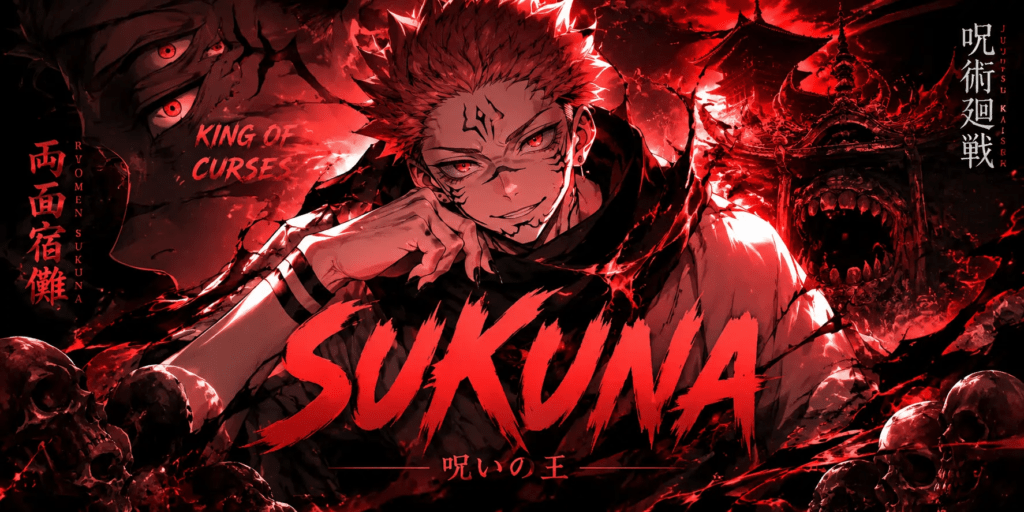
There are villains you fear because of what they’ve done. Then there’s Ryomen Sukuna pfp— a character you fear because of what he is.
From the moment Yuji Itadori swallowed that first rotten finger, the entire balance of Jujutsu Kaisen shifted. Not because a new threat emerged — but because an ancient one woke up inside a teenager’s body.
This guide covers everything: his Heian-era origins, his horrifying techniques, his takeover of Megumi Fushiguro, and why millions of fans around the world consider him one of the greatest antagonists in manga and anime history.
Who Is Sukuna, Exactly?
Ryomen Sukuna is the central antagonist of Jujutsu Kaisen, created by Gege Akutami and published by Shueisha. He is not simply a powerful villain — he is a former human sorcerer who became something closer to a natural disaster.
During the Heian era, when cursed energy was at its peak across Japan, Sukuna rose above every sorcerer alive. No one could kill him. No one could even come close. Rather than destroy his remains after death, the jujutsu world made a desperate choice: they sealed his power inside twenty cursed fingers and scattered them.
That decision set the entire plot of Jujutsu Kaisen in motion.
He currently exists as a cursed spirit inhabiting a host body. For most of the series, that host is Yuji Itadori. Later — and far more dangerously — he takes permanent control of Megumi Fushiguro.
The Heian Period: The Origin of the Legend
To understand Sukuna’s power, you need to understand the world that created him.
The Heian period in Japan is considered the golden age of cursed energy. Negative human emotions ran freely through the population, giving birth to powerful curses and exceptionally strong sorcerers. It was a brutal, chaotic era — and Sukuna thrived in it.
He stood apart not just in strength, but in ambition and cruelty. While sorcerers of that era dedicated their lives to protecting humanity, Sukuna indulged every dark impulse without apology. Villages feared him the way they feared natural disasters. Some communities offered human sacrifices just to avoid drawing his attention.
His original physical form reflected that monstrous nature — four arms, two faces, and a body marked with ancient tattoos. He was not a human who became a curse. He was a human who chose to be one.
Sukuna’s True Form: Four Arms and No Mercy
Heian-era sorcerers detailed Sukuna’s real form, which contemporary jujutsu practitioners fear learning.Two faces, four arms, eyes and mouths carved into his skin — it is a body built for destruction from every angle simultaneously.
This form becomes directly relevant when he completes his incarnation during the Culling Game arc. After taking over Megumi Fushiguro’s body, he gradually pushes toward fully manifesting his original self through that new vessel. The result combines his ancient cursed traits with access to the Ten Shadows Technique, which amplifies his already catastrophic capabilities.
When he reaches this state, even veteran sorcerers who have spent years preparing for battle with him are forced to rethink everything they know.
Malevolent Shrine: A Domain Unlike Any Other
Every elite sorcerer eventually develops a Domain Expansion — a technique that creates a sealed space where attacks land with guaranteed precision. Sukuna’s domain is called Malevolent Shrine, and it breaks every rule that governs how domains are supposed to work.
Standard domains create an enclosed barrier, a bubble that separates the caster’s world from the real one. Malevolent Shrine does the opposite. It binds directly to the real world without closing a barrier at all.
The result is terrifying: every structure, every person, every object within a massive surrounding radius becomes a target for his two signature slashes — Dismantle and Cleave — simultaneously and continuously. There is no sealed space to escape into. The shrine simply is the environment around you, and within it, nothing survives unchanged.
It is arguably the most destructive domain in the entire series, not because of raw power alone, but because of its sheer coverage and the fact that it cannot be countered by simply leaving the barrier.
His Techniques: Precision Meets Annihilation
Sukuna’s cursed techniques are elegant in a way that makes them even more frightening. He does not attack wildly. Every strike is calibrated.
Dismantle — A raw slashing attack aimed at the physical body. Fast, clean, and lethal against anyone without exceptional defenses.
Cleave — The more intelligent of the two. This slash reads the target’s cursed energy level and adjusts its cutting power accordingly, effectively guaranteeing a fatal wound regardless of how strong the opponent is.
Fire Arrow — A powerful ranged technique Sukuna deploys against opponents who try to create distance. It removes the option of fighting him from afar.
What makes these techniques uniquely dangerous is not just their individual power — it is that Sukuna uses all of them with the precision of someone who has spent over a thousand years refining his craft. He does not make mistakes in battle. He makes choices.
How He Took Over Megumi Fushiguro
This storyline is one of the darkest in Jujutsu Kaisen, and it deserves careful attention.
Sukuna spent much of the series observing Megumi Fushiguro from inside Yuji’s body. He recognized something in Megumi that most others overlooked — an exceptional, unrefined potential tied to the Ten Shadows Technique, one of the most powerful inherited abilities in the jujutsu world.
His plan was not built on strength alone. It was built on grief.
By engineering a situation where Megumi’s beloved sister Tsumiki was placed in mortal danger and then taken from him anyway, Sukuna broke Megumi’s will to fight back. A person in complete spiritual collapse cannot resist a curse occupying their body. Sukuna used that window to make the possession permanent.
This was not a brute-force takeover. It was a psychological operation that took months of patience and deliberate cruelty to execute. And it worked.
Gojo vs. Sukuna: The Fight That Defined a Generation
There are anime battles that are well-animated. There are battles that are emotionally significant. The Gojo versus Sukuna fight is both — and it may never be topped within this series.
Satoru Gojo enters the battle widely considered the strongest sorcerer alive in the modern era. His Infinity technique creates an impenetrable barrier that automatically weakens anything approaching him. It is a passive, constant defense that has made him effectively invincible throughout the series.
Sukuna’s problem is not power. It is that Infinity cannot be dismantled by force alone — it requires a technique that can adapt faster than Infinity can neutralize it.
His solution involves Mahoraga, the most powerful and uncontrollable shikigami within the Ten Shadows Technique. Every time Mahoraga is struck, it adapts its wheel and finds a way past that specific type of attack. Sukuna essentially uses Mahoraga as a testing mechanism — letting it absorb Gojo’s Infinity repeatedly until it evolves an answer. Then he copies the adaptation.
It is one of the most intelligent combat strategies in modern shonen manga, and MAPPA’s animation of the sequence elevated it even further. The result — Gojo’s defeat — shook the fandom like few story moments have.
Why Sukuna Stands Apart from Other Anime Villains
Most memorable antagonists arrive with trauma attached. A cruel childhood. A society that failed them. A love they lost. Their evil becomes understandable, even if unforgivable.
Sukuna has none of that scaffolding — and that is precisely what makes him so striking.
He was not created by suffering. He chose power. He chose cruelty. He finds genuine pleasure in combat, in breaking opponents at their peak, in watching people realize that everything they worked toward still wasn’t enough. His amusement during the Gojo fight is not performed. It is real.
This lack of tragic justification is unusual in the genre and, paradoxically, makes him more compelling. He doesn’t want redemption. He doesn’t have a hidden soft side waiting to be unlocked. He is exactly what he appears to be, and that consistency is its own kind of terrifying.
Sukuna’s Role in the Larger Story
Sukuna is not just the villain. He is the measuring stick.
Every major character in Jujutsu Kaisen is defined, in part, by where they stand relative to him. Yuji’s growth as a fighter is measured against what Sukuna can do inside his own body. Gojo’s entire identity as the strongest is tested and eventually broken against him. Every battle in the Culling Game exists, directly or indirectly, because Sukuna is trying to complete his resurrection.
He also destroys the existing order of the jujutsu world. Leaders fall. Institutions crumble. The old rules about how curses are handled and how sorcerers operate become irrelevant in the face of what he represents. The story’s younger characters are not just fighting to survive — they’re fighting to build something new in the wreckage he leaves behind.
Complete Character Reference
| Detail | Information |
| Full Name | Ryomen Sukuna |
| Title | King of Curses |
| Origin Era | Heian Period, Japan |
| Primary Vessel | Megumi Fushiguro (formerly Yuji Itadori) |
| Core Techniques | Dismantle, Cleave, Fire Arrow |
| Domain Expansion | Malevolent Shrine |
| Cursed Objects | 20 Fingers |
| Known Ally | Uraume |
Frequently Asked Questions
Who is Sukuna in Jujutsu Kaisen?
Ryomen Sukuna is the series’ primary antagonist — a sorcerer from the Heian era who became the most powerful curse in history. After his death, his power was sealed inside twenty fingers. He currently inhabits the body of Megumi Fushiguro after a long period of sharing Yuji Itadori’s body.
What is Malevolent Shrine?
It is Sukuna’s Domain Expansion. Unlike standard domains that create a closed barrier, Malevolent Shrine binds to the open real world and continuously unleashes Dismantle and Cleave slashes across a massive radius. Escape is nearly impossible.
Who wins the Gojo vs. Sukuna fight?
Sukuna wins. He uses Mahoraga’s adaptive ability to develop a counter to Gojo’s Infinity, then delivers a fatal blow. The victory firmly establishes him as the strongest being in the current era of the story.
What does Sukuna’s true form look like?
His original body had two faces, four arms, and was marked with tattoo-like patterns across the skin. This is the form described by Heian-era sorcerers and the one he moves toward reconstructing as the story progresses.
How many cursed fingers does Sukuna have?
Twenty. Each one represents a piece of his sealed power. The hunt to collect and control them forms a central thread across the entire series.
Why is Sukuna so powerful?
He combines an extraordinary base level of cursed energy with over a thousand years of combat experience, two devastating precision techniques, access to the Ten Shadows Technique, and an intelligence in battle that few characters in the series can match