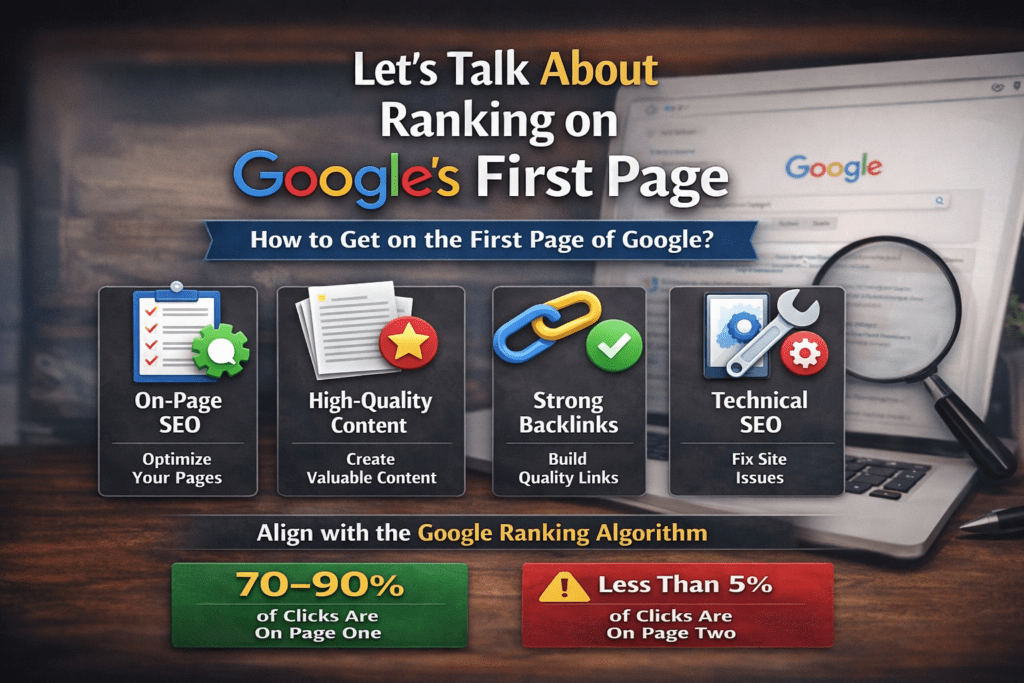
Ranking on Google’s First Page requires strong On-Page SEO, High-Quality Content, a powerful backlink profile, technical SEO stability, and alignment with the Google ranking algorithm.
To rank on first page Google, you must use proper keyword research tools, competitor analysis tools, and backlink monitoring tools. Many businesses use platforms like SEO Tools Group Buy to access multiple premium SEO tools in one place for keyword research for SEO, backlink profile analysis, and content optimization.
Google first page ranking depends on measurable SEO ranking factors such as search intent alignment, domain authority, page authority, mobile-first indexing, and user experience SEO signals.
- Relevance — Your content must match search intent precisely.
- Authority — Your domain authority and page authority must signal trust.
- Experience — Your site speed, mobile-friendliness, and user experience must meet performance standards.
Why the First Page Matters
There are 10 standard organic search results on a Search Engine Results Page (SERP). Studies show that:
- Position #1 receives 27–35% click through rate.
- Top 3 positions receive over 60% combined clicks.
- Page two results receive less than 5% of total clicks.
This means that if your page ranks outside the First Page, organic traffic drops sharply.
Organic search ranking directly affects:
- Website traffic volume
- Lead generation
- Sales conversions
- Brand visibility
- Market authority
Google prioritizes results that solve the searcher’s problem completely. If your page fails to satisfy intent, the algorithm assigns lower ranking signals.
What Happens If Your Website Is Not on the First Page
When a website ranks on page two or beyond:
- Click through rate falls below 2%.
- Organic traffic stagnates.
- Backlink acquisition slows.
- Domain authority growth becomes slow.
- Competitors dominate search visibility.
Low ranking also impacts trust. Users perceive top results as more reliable. Appearing below page one weakens brand perception.
Improving search engine ranking increases organic traffic consistently over time, unlike paid traffic which stops when advertising stops.
What This Guide Will Teach You
This guide explains how to:
- Understand Google First Page ranking structure
- Analyze SERP Features strategically
- Apply SEO ranking factors correctly
- Improve keyword ranking step by step
- Optimize for Featured Snippets
- Rank in Knowledge Panels
- Appear in Local Pack results
- Improve mobile-first indexing compliance
- Strengthen backlink profile
- Conduct a technical SEO audit
- Increase domain authority safely
- Improve content optimization for ranking
The goal is structured website ranking optimization.
Main navigation
This section explains the framework behind ranking.
What Is Google First Page Ranking?
Google First Page ranking means appearing within the top 10 organic results after a search query.
Organic results are unpaid listings selected based on:
- Keyword relevance
- Search intent alignment
- Content depth
- Authority signals
- Technical SEO health
Ranking on Google’s First Page increases organic search visibility and improves online presence.
How Google Ranking Algorithm Works
The Google ranking algorithm works in 4 core stages:
- Crawling Google bots scan websites and follow links.
- Indexing Pages are stored in Google’s index if they meet quality standards.
- Evaluating Signals Google measures ranking signals including:
- Keyword placement
- Backlink profile strength
- Page authority
- Domain authority
- User experience SEO metrics
- Core Web Vitals
- Mobile-first indexing compatibility
- Index coverage status
- Crawl errors
- Ranking Google assigns positions based on relevance and authority compared to competitors.
Google updates and ranking changes occur frequently. Algorithm updates refine how signals are weighted.
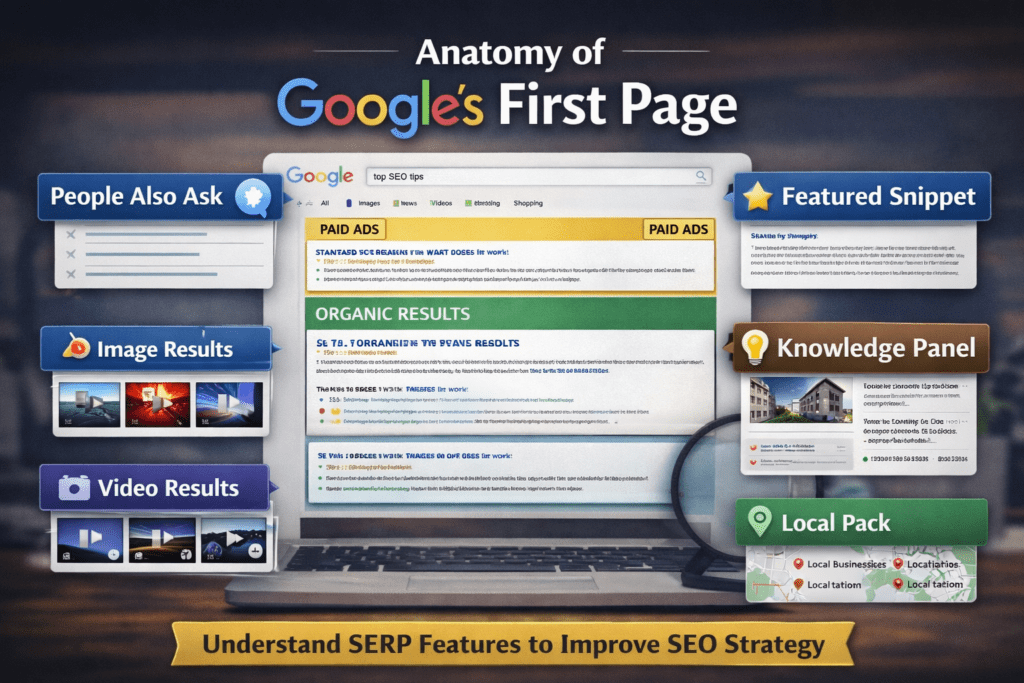
Types of SERP Features
Modern SERP Features extend beyond basic organic listings.
These include:
- Featured Snippets
- Knowledge Panels
- Local Pack
- People Also Ask
- Image results
- Video results
These features often appear above traditional organic results and affect click behavior.
For example, Featured Snippets can capture traffic even if your organic position is #3 or #4.
Understanding SERP Features improves SERP analysis accuracy and ranking strategy.
SEO Ranking Factors Overview
SEO ranking factors can be grouped into 5 measurable pillars:
- On-Page SEO Title tags, meta descriptions, headers, keyword usage.
- Technical SEO Site speed, mobile friendly design, index coverage, crawl errors.
- High-Quality Content Relevance, depth, semantic coverage, NLP keywords.
- Backlink Profile Quality links, anchor diversity, authority sources.
- User Experience Engagement time, bounce rate, interaction signals.
Each pillar contributes to website ranking optimization.
Ignoring one pillar weakens overall ranking strength.
Time Required to Rank
Ranking time depends on competition and authority level.
- Low competition keywords: 3–6 months.
- Medium competition keywords: 6–9 months.
- High competition keywords: 6–12 months or longer.
New websites take longer because domain authority is initially low.
Established websites rank faster due to existing backlink profile strength.
Free vs Paid Ranking Methods
Free ranking focuses on organic search ranking through:
- Keyword research for SEO
- Content optimization for ranking
- Internal linking
- Improve page speed
- Build backlinks manually
- Search intent optimization
Paid ranking includes:
- Google Ads
- Sponsored placements
Organic ranking builds long-term search visibility. Paid ads generate instant traffic but stop when budget ends.
Website vs Blog vs YouTube vs Google My Business Ranking
Each platform uses different ranking signals.
Website ranking depends on technical SEO, backlink profile, and structured content.
Backlink profile strength increases domain authority and improves organic search ranking. To analyze backlinks, anchor text distribution, referring domains, and keyword difficulty, SEO professionals use tools like Ahrefs.
Many businesses access tools like Ahrefs Group Buy Seo Tools to perform competitor analysis, track keyword ranking, and improve content optimization strategies without paying full premium subscription costs.
Strong backlink profile combined with search intent optimization increases ranking probability on Google’s First Page.
Blog ranking depends on consistent publishing, topical authority, and internal linking.
YouTube ranking depends on video SEO, watch time, and engagement signals.
Google My Business ranking depends on:
- Reviews volume
- Proximity to searcher
- NAP consistency
- Profile completeness
- Local SEO ranking signals
To rank first on Google My Business, optimize profile details and collect authentic reviews.
Understanding SERP Features
A Search Engine Results Page (SERP) is the page Google shows after a user enters a query. Ranking on Google’s First Page depends on understanding how SERP Features work and how they affect organic search ranking.
Modern SERP is dynamic. It changes based on search intent. For informational queries, Google often shows Featured Snippets and People Also Ask. For local queries, Local Pack appears. For branded queries, Knowledge Panels appear.
SERP analysis helps improve search engine ranking because it shows what type of content Google prefers for a keyword.
If the SERP shows:
- List-style results → create structured lists
- Video results → embed optimized videos
- Image packs → add optimized images
- Local Pack → focus on local SEO ranking
Mobile SERP differs from desktop SERP. Google uses mobile-first indexing, meaning it primarily evaluates the mobile version of a website for ranking.
Google updates and ranking changes frequently adjust how results appear. Algorithm updates refine how relevance, authority, and user experience signals are weighted.
Understanding SERP Features allows better content optimization for ranking.
Strategies for Reaching the First Page
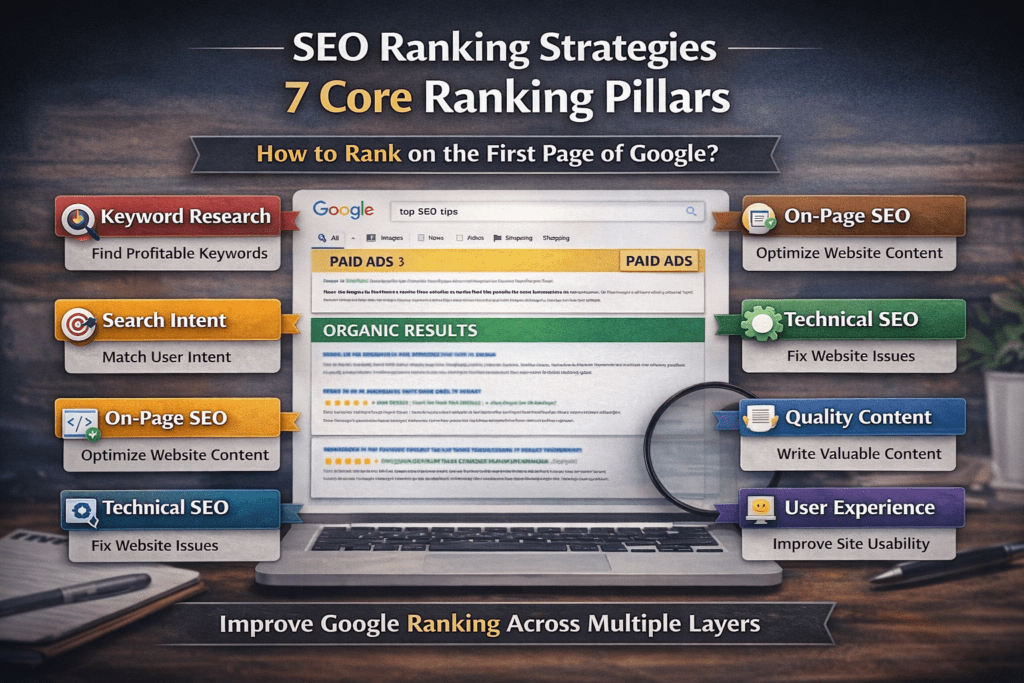
There are 7 core ranking pillars that directly influence how to rank on first page of google.
- Keyword research for SEO
- Search intent optimization
- On-Page SEO
- Technical SEO
- High-Quality Content
- Backlink profile building
- User experience optimization
Each pillar supports website ranking optimization. Ignoring one weakens overall performance.
Keyword research identifies terms users search for. Tools and Search Console data reveal search volume, difficulty, and intent.
Search intent optimization ensures your content matches what users expect. If the intent is informational, provide a detailed guide. If commercial, provide comparison and benefits.
Technical SEO ensures Google can crawl, index, and evaluate pages correctly. Crawl errors, index coverage issues, or broken internal links reduce ranking potential.
Backlink profile strength increases domain authority. Links from authoritative domains transfer trust signals.
User experience SEO includes site speed, mobile friendly design, and engagement signals.
When these pillars align, Google ranking algorithm increases visibility.
On-Page SEO Best Practices
On-Page SEO directly affects Google first page ranking.
Optimize title tags under 60 characters. Include primary keyword naturally.
Write clear meta descriptions that encourage click through rate.
Use header hierarchy correctly. Each section should follow logical structure.
Use the primary keyword “how to rank on first page of google” naturally in introduction, headings, and body without stuffing.
Improve internal linking to distribute page authority across your site.
Use descriptive URLs.
Add image alt text for accessibility and SEO relevance.
Improve page authority by strengthening internal and external signals.
Domain authority increases gradually through consistent content publishing and link building.
On-Page SEO is fully controllable. It is the first layer of optimization.
Creating High-Quality, Relevant Content
High-Quality Content is the strongest ranking driver.
To rank blog on Google first page, content must:
- Match search intent exactly
- Cover topic depth fully
- Use semantic keywords and NLP keywords
- Provide clear answers
- Include structured subtopics
- Be updated regularly
Topical authority improves organic search ranking. When multiple related articles link together, Google sees expertise.
To rank website on Google first page free, focus on:
- Content optimization
- Internal linking
- Search intent alignment
- Consistent publishing
To rank YouTube videos on first page of Google, optimize:
- Video title
- Description
- Tags
- Engagement metrics
To rank website on Google first page in Hindi, create localized relevant content with proper keyword research.
E-A-T SEO signals improve credibility. Add author information, cite trusted sources, and provide accurate data.
Content strategy must focus on long-term value, not short-term tricks.
Mobile-Friendliness, Accessibility, and Site Speed
Google prioritizes mobile-first indexing.
A mobile friendly design ensures usability across devices.
Site speed directly affects ranking. Improve page speed optimization by:
- Compressing images
- Using fast hosting
- Reducing unnecessary scripts
- Implementing caching
Core Web Vitals measure:
- Loading performance
- Interaction responsiveness
- Visual stability
Fix crawl errors and index coverage issues through regular technical SEO audit.
Accessibility improves user experience. Use readable fonts, structured headings, and proper contrast.
Search Console helps monitor performance, indexing status, and errors.
Improving site speed and accessibility increases engagement and reduces bounce rate.
Additional Ranking Questions
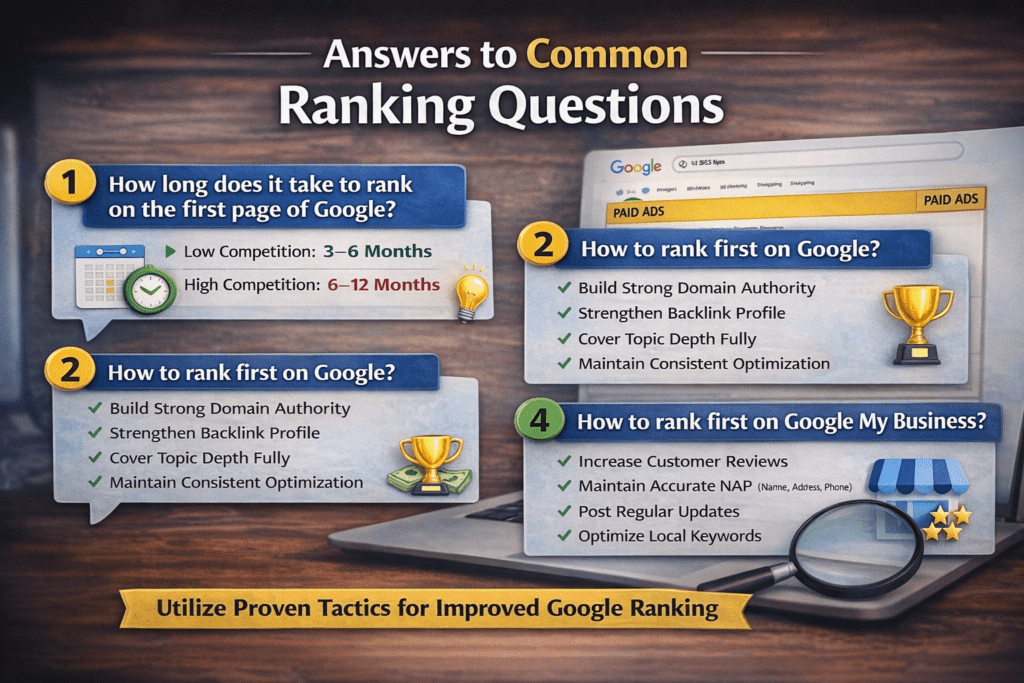
How long does it take to rank on the first page of Google?
Low competition keywords rank in 3–6 months. Competitive keywords require 6–12 months. Authority and backlink profile strength influence speed.
How to rank first on Google?
Build strong authority, improve domain authority, strengthen backlink profile, create deep topical authority, and maintain consistent optimization.
How to rank website on Google first page for free?
Create High-Quality Content, apply On-Page SEO, optimize internal linking, improve site speed, and align with search intent.
How to rank first on Google My Business?
Increase reviews, maintain NAP consistency, ensure proximity relevance, and complete profile details accurately.
Do You Need Marketing Assistance?
Marketing Assistance becomes necessary when:
- SEO becomes technically complex
- Competition is high
- Backlink profile is weak
- Technical SEO issues persist
- Organic traffic declines
Professional Marketing Assistance includes:
- Technical audit
- Content optimization
- Link building strategy
- Local SEO optimization
- Performance tracking
Expert support accelerates ranking and prevents costly mistakes.
Recent Articles
Publishing Recent Articles strengthens internal linking structure and builds content clusters.
Related SEO guides improve topical authority.
A structured blog strategy improves organic traffic and keyword ranking.
Consistent publishing increases domain authority over time.
LinkedIn feed
LinkedIn supports authority signals.
Sharing SEO insights builds professional credibility.
Publishing ranking case studies increases trust.
Building personal brand improves indirect ranking signals.
LinkedIn traffic supports search visibility growth.
Conclusion
Ranking on Google’s First Page requires structured optimization, authority building, and consistent improvement.
Success depends on understanding the Anatomy of the First Page, leveraging SERP Features, applying On-Page SEO, producing High-Quality Content, improving Site Speed, and using Marketing Assistance when necessary.
When keyword research, technical SEO, backlink profile building, and user experience work together, ranking on Google’s First Page becomes achievable.