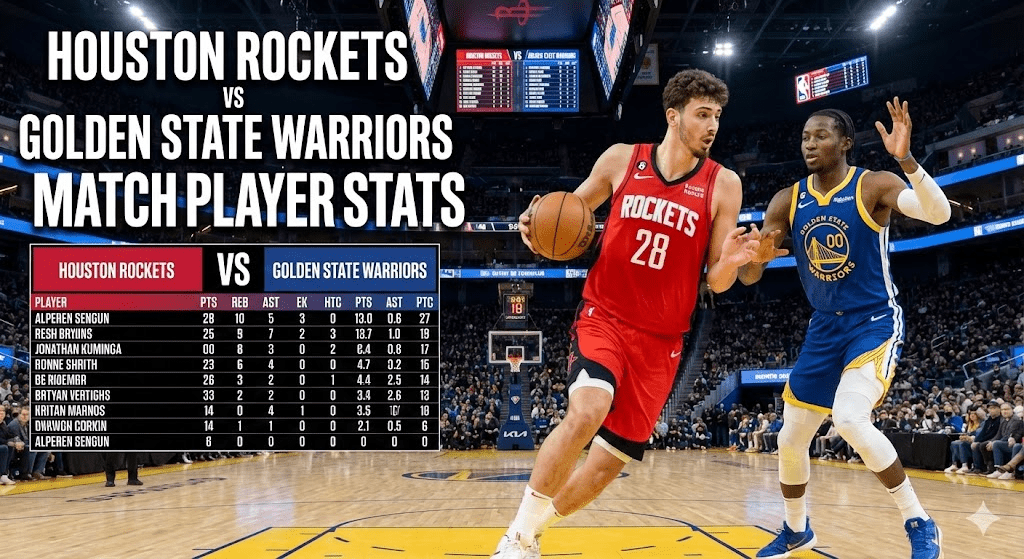
Houston Rockets vs Golden State Warriors Match Player Stats
Introduction
Basketball fans always get excited when the Houston Rockets vs Golden State Warriors face each other. Every game is filled with energy, high-speed action, and intense competition. While the final score tells part of the story, player stats reveal how each player contributed. Stats like points, rebounds, assists, steals, and blocks show who played well, who made key plays, and how the game was won or lost.
In this article, we will break down recent games, explain key stats, highlight top performers, and show how stats tell the full story. We’ll also provide a detailed table of player stats so you can easily see who made the biggest impact. This guide is simple, easy to read, and perfect for fans who want to understand every part of the game.
Why Player Stats Matter
Player stats are important because they show effort, contribution, and efficiency. Scoring points is good, but rebounds, assists, and defense are equally critical. A player might score many points, but if another grabs rebounds and makes key assists, they could be the real hero of the match.
In a Rockets vs Warriors game, stats help fans see whether a team played as a unit, relied on one star, or dominated in defense. Coaches also use these numbers to plan strategies and rotations. Understanding stats allows fans to follow the game more deeply and enjoy every moment.
Key Stat Categories Explained
Here’s a simple guide to the main stats you’ll see in a Rockets vs Warriors matchup:
- Points (PTS): How many points a player scored.
- Rebounds (REB): Balls recovered after missed shots. Offensive rebounds give second chances; defensive rebounds stop the opponent.
- Assists (AST): When a player passes the ball to a teammate who scores. Shows teamwork.
- Steals (STL): Taking the ball from the opponent. Shows defensive skill.
- Blocks (BLK): Stopping an opponent’s shot. Also a defensive measure.
- Turnovers (TO): Losing the ball. Too many turnovers hurt the team.
- Shooting Percentages: Field goal %, 3-point %, and free throw %. Shows efficiency in scoring.
Understanding these categories makes it easier to read the player stats table and know who impacted the game most.
Recent Match Overview: Rockets 104–100 Warriors
This table shows how each player contributed to their team. Notice that the Rockets had multiple players with solid rebounds and assists, which helped them edge the Warriors in a tight finish..
How Stats Tell the Story
Player stats tell the story of the match beyond the final score. Here’s what we can learn from the table:
- Reed Sheppard led the Rockets in points, giving his team a scoring boost.
- Alperen Şengün’s rebounds and blocks made a difference defensively.
- Jonathan Kuminga was unstoppable for the Warriors, scoring 33 points.
- The Rockets had balanced contributions, while Warriors relied heavily on stars.
This is why checking player stats is exciting — it shows how individual efforts combine to determine the outcome.
Why Games Can Be Close
Rockets vs Warriors games are often close because both teams have strong scoring, skilled shooters, and good defense. Factors that influence closeness include:
- Balanced scoring across multiple players
- Strong defensive efforts with steals and blocks
- Team turnovers and missed shots
- Momentum shifts and clutch performances
Stats help fans see why a game ended closely or why one team pulled ahead.
Patterns in Rockets vs Warriors Matchups
Looking at past games, we notice some trends:
- One star player often scores 25–35 points.
- Balanced team contributions often win close games.
- Defense and rebounds are key to controlling the game.
- Games are usually competitive, with small margins deciding the winner.
These patterns make each matchup exciting for fans and analysts.
Tips for Following Player Stats
If you want to enjoy the game fully, here’s how to follow stats:
- Watch who scores, but also check rebounds and assists.
- Notice defensive contributions — steals and blocks matter.
- Check turnovers — too many hurt the team.
- Look at shooting percentages — they show efficiency.
- Observe which players contribute consistently, not just stars.
By combining stats with watching the game, you understand both the numbers and the action.
Common Mistakes When Reading Stats
Stats are helpful but not perfect. Common mistakes include:
- Judging a player only by points scored.
- Ignoring defensive contributions not reflected in steals or blocks.
- Assuming a high-scoring player always helped the team win.
Combining stats with watching gameplay gives the full picture.
FAQs:
Q1: What are match player stats?
A: They show each player’s performance in a game — points, rebounds, assists, steals, blocks, and more.
Q2: Why are stats important?
A: Stats reveal who contributed, who defended well, and who made mistakes. They help fans and analysts understand the game.
Q3: Can a player have great stats if their team loses?
A: Yes, a player may score or rebound a lot, but if the team struggles elsewhere, they can still lose.
Q4: Which stat is most important?
A: No single stat is most important. Points, rebounds, assists, steals, blocks, and turnovers all matter.
Q5: How do turnovers affect the game?
A: Losing the ball gives opponents more scoring opportunities. High turnovers can cost the game.
Q6: How can fans use stats to enjoy games more?
A: Check the box score to see who scored, rebounded, or assisted. Then watch highlights to connect stats with action.
Conclusion:
Player stats make Houston Rockets vs Golden State Warriors games more exciting. They tell the story of the game, reveal heroes, and show how teamwork and individual efforts shape the outcome. Watching stats along with the game helps fans understand every point, rebound, and assist.
Next time you watch a Rockets vs Warriors match, check the player stats table. Notice who shines, who defends, and how the team works together. Stats are not just numbers — they are the heartbeat of the game.
You May Also Like To Read “Portland Trail Blazers vs Phoenix Suns Match Player Stats | Complete Game Breakdown“
About the Author
