Buying your first greenhouse is one of those gardening milestones that, once crossed, tends to produce a single reaction: I should have done this years ago. The ability to start seeds in late winter, to overwinter tender plants without hauling them into the spare bedroom, to grow tomatoes that actually taste of something — these are pleasures so significant that many gardeners wonder how they ever managed without a greenhouse.
And yet the purchase itself can feel daunting: there are so many sizes, materials, styles, and price points that it is easy to end up paralysed by options.
This guide is intended to cut through that paralysis. Whether you are looking at a modest cold growhouse to extend your season by a few weeks or a proper glazed greenhouse with heating and staging, the fundamental questions are the same. Answer them honestly and you will end up with a structure that serves you well for many years.
What Do You Actually Want to Do?
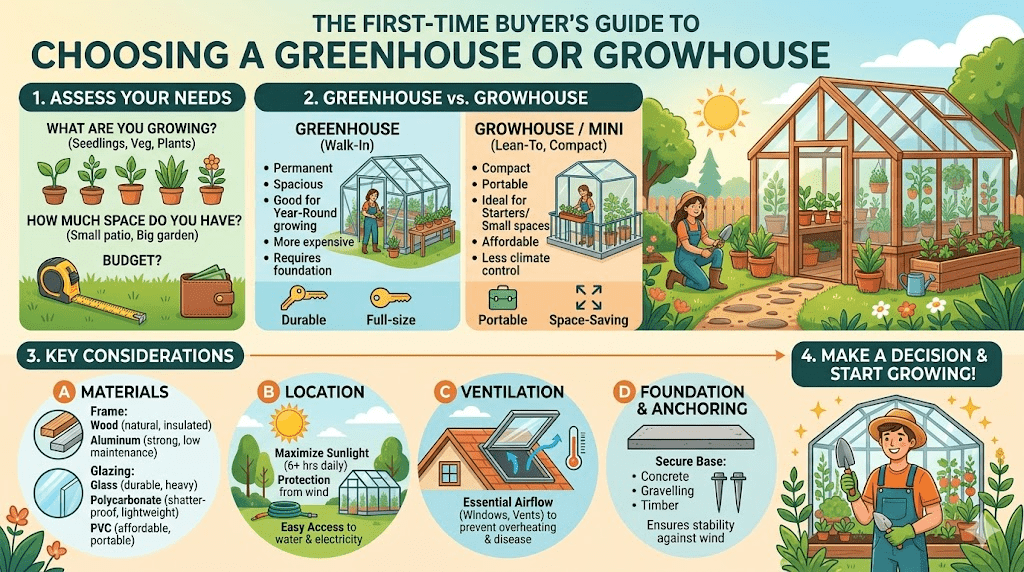
Begin not with the structure but with the purpose. Greenhouses and growhouses serve rather different functions, and conflating the two is one of the most common first-time buying mistakes. A growhouse — typically a lightweight, shelved structure with a zip-up cover — is primarily a season-extender and propagation aid. It keeps frost off tender seedlings, provides a sheltered environment for hardening off plants raised indoors, and can protect early-sown vegetables during cold snaps.
A greenhouse, by contrast, is a permanent or semi-permanent structure that can support a far wider range of growing activities: year-round propagation with or without supplementary heat, the cultivation of tender exotics that would not survive a British winter outdoors, productive crops of tomatoes, cucumbers, aubergines, and peppers throughout the growing season, and overwintering of the kinds of plants — dahlias, cannas, fuchsias, half-hardy pelargoniums — that would otherwise perish.
Be honest with yourself about which category you actually need. If you know you want to grow tomatoes seriously or overwinter significant quantities of tender plants, save for a proper greenhouse rather than spending money on something you’ll outgrow.
Size: The Universal Error
Almost every experienced greenhouse gardener gives the same advice: buy bigger than you think you need, because you will fill it. The growing space within a greenhouse fills with remarkable speed. As a practical guide: a 6x4ft greenhouse is a useful minimum for a single gardener with modest ambitions; 6x8ft gives considerably more flexibility; 6x10ft or larger starts to feel genuinely spacious. Always err on the larger side — the incremental cost between sizes is usually modest; the difference in usable growing space is significant.
Glass, Polycarbonate, or Polyethylene?
Glass remains the gold standard for light transmission and is the most attractive option aesthetically. The downsides are weight, cost, and the minor hazard that broken panes create. Polycarbonate offers superior insulation, is lightweight and virtually unbreakable, and is far less expensive — the trade-off is slightly reduced light transmission. Polyethylene film covers, used on polytunnels and growhouses, transmit light well and are very inexpensive, but they degrade over time under UV exposure.
Aluminium or Timber Frames?
Aluminium is the practical choice for most gardeners: lightweight, strong, virtually maintenance-free, and the standard framework for modern greenhouse kits. Timber-framed greenhouses have a warmth and visual quality that aluminium cannot match, and they sit more naturally in ornamental garden settings. The downside is maintenance: timber frames need regular treatment to prevent deterioration.
Siting for Success
The fundamental requirement is light: a minimum of six hours of direct sunlight per day during the growing season. In practical terms this means an open, south or south-east facing position, well away from the shade of trees or buildings. Two additional considerations matter significantly: shelter from prevailing winds, and proximity to the house. A greenhouse that is convenient to reach year-round will be used far more than one requiring a long trek across a wet lawn.
Growing Organically Under Glass
One of the great advantages of greenhouse growing is the degree of control it gives you over the growing environment, and many gardeners use this as an opportunity to move towards more organic methods. Biological controls for common greenhouse pests — predatory mites for red spider mite, parasitic wasps for whitefly — are highly effective in the enclosed environment of a greenhouse and eliminate the need for chemical sprays. Garden Organic’s grow-your-own resources are an excellent reference for anyone wishing to develop a more sustainable approach to greenhouse growing, covering soil health, pest management, and variety selection.
The Kitchen Garden Connection
A greenhouse sits most naturally at the heart of a productive kitchen garden, providing the season-extension and propagation capacity that makes the rest of the food-growing plot function so much better. If you’re thinking about how a greenhouse might integrate into a wider kitchen garden scheme, The English Garden’s kitchen garden planning advice covers layout, crop rotation, and the relationship between protected and unprotected growing areas in useful detail.
Making Your Decision
For a practical look at the range of structures currently available — including both traditional glazed greenhouses and modern growhouse designs — it is worth exploring the Dobbies greenhouse and growhouse range, which stocks options at various sizes and price points suitable for most UK garden situations.
Whatever you choose, commit to using it fully. The worst outcome is an expensive structure that fills with clutter. A house is only as good as the ambition you bring to it — and that ambition, once a first real crop of tomatoes comes in, tends to grow very rapidly indeed.
The First-Time Buyer’s Guide to Choosing a Greenhouse or Growhouse